
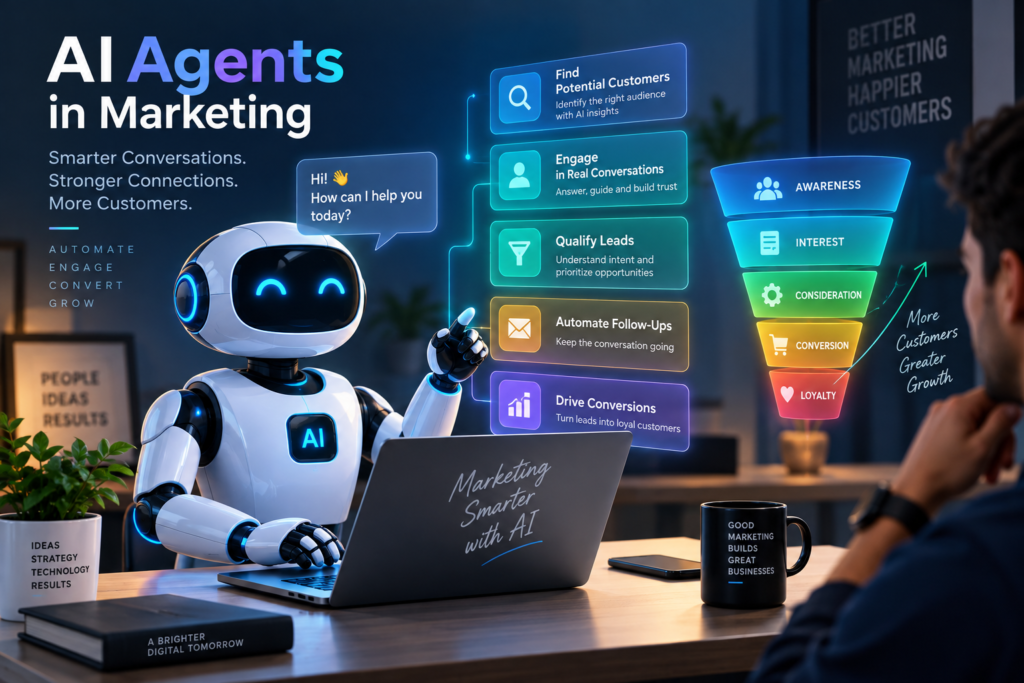
Digital marketing is entering a new phase. For years, businesses have used automation to schedule social media posts, send emails, manage advertising campaigns, and nurture leads. Now, AI agents in marketing are taking automation a step further.
Unlike traditional automation tools that follow predefined rules, AI agents can understand goals, analyze information, make decisions, interact with customers, and perform multiple tasks with limited human intervention. This makes them an emerging technology for businesses looking to automate and improve customer acquisition.
From finding potential customers to answering questions, qualifying leads, and supporting conversions, AI agents could transform how businesses build their marketing funnels.
What Are AI Agents in Marketing?
An AI agent is a software system powered by artificial intelligence that can perceive information, reason about a task, make decisions, and take actions to achieve a specific goal.
Traditional marketing automation might work like this:
Customer fills out a form → automation sends an email → lead enters a predefined sequence.
An AI-powered system can operate more dynamically:
Customer interacts with the business → AI analyzes intent → determines the appropriate response → qualifies the lead → recommends an action → updates the CRM → triggers the next step.
The key difference is adaptability. Instead of simply executing a fixed workflow, an AI agent can respond to changing circumstances and customer behavior.
How AI Agents Can Automate Customer Acquisition
Customer acquisition involves multiple stages, from attracting prospects to converting them into customers. AI agents can potentially assist across almost every stage of this journey.
1. Finding and Researching Potential Customers
AI agents can help businesses identify potential customer segments by analyzing available market and customer data.
For example, an agent could examine customer profiles, website interactions, previous campaigns, and market information to identify characteristics shared by high-value customers.
This can help marketing teams focus their efforts on audiences that are more relevant to their products or services.
2. Creating Personalized Marketing Experiences
Personalization has become an important part of digital marketing.
Instead of showing every visitor the same message, AI agents can analyze signals such as browsing behavior, previous interactions, interests, and customer intent.
A visitor researching a service for the first time might receive educational content, while someone who has already viewed pricing information could receive a more conversion-focused experience.
This creates a more contextual customer journey.
3. Conversational Lead Generation
AI agents can also act as conversational interfaces on websites and messaging platforms.
Rather than asking visitors to complete long forms, an AI agent can have a natural conversation with them.
For example, it could ask:
- What service are you looking for?
- What is your primary business goal?
- When are you planning to start?
- What type of solution do you need?
Based on the conversation, the system can determine whether the visitor is a potential lead and collect relevant information for the sales team.
This can make lead generation available around the clock.
4. Lead Qualification
Not every lead has the same level of purchase intent.
AI agents can analyze conversations and customer behavior to categorize leads according to predefined business criteria.
A highly interested prospect who has requested pricing and implementation information could be routed to a salesperson, while someone who is still researching could enter an educational content journey.
This allows sales teams to spend more time on conversations that require human involvement.
5. Automated Follow-Ups
One of the biggest challenges in customer acquisition is inconsistent follow-up.
A potential customer might submit an inquiry but never receive a timely response. AI agents can help automate follow-up processes while adapting messages based on the customer’s previous interactions.
For example, an agent could recognize that a prospect downloaded a guide, visited a pricing page, and later requested additional information.
Instead of sending a generic follow-up, the system could initiate a more relevant conversation.
AI Agents and the Marketing Funnel
AI agents can potentially connect different stages of the marketing funnel.
Awareness → Interest → Consideration → Conversion → Retention
At the awareness stage, AI can help analyze audiences and identify content opportunities.
During consideration, AI agents can answer questions, recommend resources, and provide personalized information.
At the conversion stage, they can qualify leads, assist with inquiries, schedule meetings, or route prospects to the appropriate sales representative.
After conversion, AI can continue supporting customers through onboarding, communication, and retention workflows.
This creates a more connected customer journey instead of treating each marketing activity as a separate process.
AI Agents vs Traditional Marketing Automation
Traditional automation remains useful, especially for predictable and repetitive workflows.
However, there is an important distinction.
Traditional automation:
“If X happens, do Y.”
AI agent:
“Here is the goal. Analyze the situation, decide what action is appropriate, and execute the next step within defined boundaries.”
For example, traditional automation may send the same email three days after someone downloads an ebook.
An AI-powered system could consider whether the person opened the previous email, visited the website again, requested pricing, or interacted with another campaign before determining the next action.
The goal isn’t necessarily to replace traditional automation. Instead, AI agents can add intelligence and adaptability to existing marketing systems.
Benefits for Businesses
AI agents can provide several potential advantages.
24/7 Customer Engagement
AI agents can respond to customer questions outside normal business hours, helping businesses avoid losing prospects simply because nobody is available.
Faster Lead Response
Speed can be important when a prospect is actively researching a product or service. AI agents can respond immediately and route qualified opportunities to the appropriate team.
Greater Scalability
A human sales or marketing team has limited capacity. AI agents can handle many routine interactions simultaneously, allowing businesses to scale certain customer-acquisition activities.
Better Data Utilization
AI agents can bring information from different interactions together, helping businesses understand customer intent and behavior more effectively.
Reduced Repetitive Work
Marketing teams can spend less time on repetitive tasks such as basic lead qualification, routine responses, data entry, and follow-up coordination.
Challenges and Risks
Despite their potential, AI agents are not a replacement for strategy or human judgment.
Poorly designed AI systems can provide inaccurate information, misunderstand customer intent, or create frustrating experiences.
Businesses also need to consider privacy, data security, transparency, brand consistency, and human oversight.
For high-value or sensitive customer interactions, businesses should establish clear boundaries around what an AI agent can decide and what must be reviewed by a human.
The most effective approach is often a combination of AI efficiency and human expertise.
How Businesses Can Prepare for AI-Agent Marketing
Businesses don’t need to automate everything immediately.
A practical starting point is to identify repetitive activities that consume significant marketing or sales resources.
For example:
- Identify repetitive customer questions.
- Map the current customer-acquisition funnel.
- Identify where leads are being lost.
- Connect relevant CRM and marketing data.
- Start with a controlled AI use case.
- Establish human-review processes.
- Measure results and improve the workflow.
The objective should be solving a specific business problem rather than adopting AI simply because it is trending.
The Future of Automated Customer Acquisition
AI agents are moving marketing automation from simple task execution toward goal-oriented systems that can reason, interact, and take action.
In the future, businesses may have specialized AI agents working across different parts of their marketing operations—one supporting lead generation, another handling customer conversations, another analyzing campaigns, and others assisting with sales and retention.
However, successful marketing will still depend on fundamentals: understanding customers, creating valuable offers, building trust, and delivering excellent experiences.
AI agents can automate many processes, but they don’t eliminate the need for a strong marketing strategy.
Conclusion
AI agents in marketing represent an important evolution in automated customer acquisition. They can help businesses engage prospects, personalize experiences, qualify leads, automate follow-ups, and connect different stages of the customer journey.
The biggest opportunity is not simply doing more marketing automatically. It is creating smarter systems that can understand customer intent and respond at the right time with the right action.
For businesses preparing for the next generation of digital marketing, learning how to combine AI agents, marketing automation, customer data, human expertise, and strong digital experiences can become an important competitive capability.
The future of customer acquisition may not be completely automated—but it is likely to be increasingly AI-assisted, personalized, conversational, and intelligent.